 Skip to contentSkip to footer


Share This Article
Explore the most iconic forts in Madhya Pradesh for a truly royal experience. Discover rich history, architecture, and stunning views.
A Regal Journey Through Madhya Pradesh’s Forts
Madhya Pradesh, the heart of India, is a land where ancient fortresses stand as silent guardians of a glorious past.
Dubbed the “Heart of Incredible India,” this central state is a treasure trove of forts in Madhya Pradesh, each a testament to valor, romance, and architectural splendor.
From the towering Gwalior Fort, where music echoed through royal courts, to the misty ruins of Mandu, steeped in tales of love, these citadels weave a tapestry of India’s medieval heritage.
Shaped by Rajput kings, Mughal emperors, Maratha warriors, and Malwa sultans, they pulse with stories of conquest and creativity.
For travelers seeking a royal adventure, Madhya Pradesh’s forts offer a journey into a world of crowns and conquests. These are not just stone structures but living legends, where every archway holds a secret and every turret whispers of glory.
This guide curates the top 10 forts, blending historical depth with vivid descriptions to transport you to a regal era. Whether you’re a history buff or a dreamer chasing royal tales, these fortresses promise an unforgettable experience.
Step into the past and let Madhya Pradesh’s majestic heritage sweep you away.
Table of Contents
Why Visit Forts in Madhya Pradesh?
Madhya Pradesh’s forts are a must-visit for their:
- Historical Richness: From Gwalior’s 8th-century origins to Orchha’s 16th-century Rajput glory, they span dynasties like Tomars, Mughals, and Holkars.
- Architectural Brilliance: Blending Rajput jharokhas, Mughal domes, and Maratha simplicity, they’re a visual feast.
- Cultural Legends: Home to poets like Tansen, lovers like Baz Bahadur, and queens like Ahilyabai, they brim with art and romance.
- Scenic Grandeur: Perched on hills or rivers, they offer breathtaking vistas, especially at sunset.
- Royal Immersion: Palaces and temples within let you walk in royal footsteps.
These forts are portals to a kingdom where history lives.

1. Gwalior Fort: The Crown of Citadels
Historical Significance
Perched over Gwalior, this 8th-century fortress, the “Gibraltar of India,” has witnessed Rajput, Mughal, and Maratha rule. Founded by the Kachchhapaghata dynasty, it thrived under Tomar king Man Singh, a patron of music. Tansen’s melodies enchanted its courts, and Rani Lakshmibai’s 1858 stand etched her bravery into its walls.
Description of Place
Imagine a golden fortress crowning a 100-meter cliff, its walls glowing like a monarch’s diadem. Gwalior Fort sprawls like a medieval kingdom, a maze of palaces and temples carved into basalt. The Man Mandir Palace dazzles with turquoise tiles and frescoes, its chambers whispering of royal intrigues. Gujari Mahal, built for Queen Mrignayani, cradles ancient sculptures, its arches framing a timeless love story.
The Saas-Bahu Temples weave 9th-century carvings like stone lace, while Teli Ka Mandir looms as a Dravidian enigma. At night, a sound-and-light show spins 1200 years of drama under starry skies. From its turrets, Gwalior’s skyline unfurls—a blend of past and present, where dreams soar.
Why You’ll Love It: Gwalior Fort’s scale and artistry make you feel like a king surveying your realm.
Nearby Attractions
- Jai Vilas Palace: Scindia residence with a silver train (2 hours).
- Tansen Tomb: Shrine for the musician (1 hour).
Duration: 3–4 hours.
Location: Gwalior.
Book your tour via GetYourGuide:

2. Mandu Fort: The City of Joy
Historical Significance
On the Malwa Plateau, Mandu Fort was the 14th–16th century “City of Joy” for Malwa Sultans. A Mughal retreat for Jahangir, it’s famed for the love story of Baz Bahadur and Rani Roopmati. Conquered by Akbar in 1562, its ruins echo romance and conquest.
Description of Place
Picture a fortress city draped in monsoon mists, its palaces floating above emerald lakes. Mandu Fort is a poet’s dream, where history hums like a sultan’s ballad. Jahaz Mahal, the Ship Palace, shimmers between waters, its domes dancing like a mirage.
Hindola Mahal sways with sloping walls, its arches hiding courtly secrets. Baz Bahadur’s Palace sings of Roopmati’s love, while her pavilion gazes at the Narmada’s silver thread. The Jama Masjid’s red sandstone soars, rivaling Damascus’s grandeur. Mandu’s ruins, kissed by rain, weave love and loss into every stone, a sultan’s paradise frozen in time.
Why You’ll Love It: Mandu’s misty ruins and romantic tales evoke a royal escape.
Nearby Attractions
- Bagh Caves: 5th-century Buddhist caves (2 hours).
- Hoshang Shah’s Tomb: Marble mausoleum (1 hour).
Duration: 4–5 hours.
Location: Mandu, Dhar.

3. Orchha Fort Complex: A Riverside Rajput Gem
Historical Significance
Along the Betwa River, Orchha Fort Complex was the 16th–17th century Bundela Rajput stronghold. Founded in 1501 by Rudra Pratap Singh, it hosted Mughal emperor Jahangir, thriving as a hub of art until 1783.
Description of Place
Envision a fortress rising from the Betwa’s green banks, its palaces gleaming like jewels. Orchha Fort is a Rajput fairy tale, blending might with elegance. Jahangir Mahal glows with turquoise domes, its latticework framing river sunsets. Raja Mahal’s Ramayana murals pulse with color, its courtyards alive with royal ghosts.
Chaturbhuj Temple soars heavenward, while riverside cenotaphs dance in twilight. Orchha feels like a secret kingdom, the Betwa’s ripples singing of Bundela valor. Wander its halls, and hear the clink of swords and rustle of silks.
Why You’ll Love It: Orchha’s intimate charm and riverside serenity feel regal and hidden.
Nearby Attractions
- Ram Raja Temple: Palace-turned-temple (1 hour).
- Laxmi Narayan Temple: Frescoed temple (1 hour).
Duration: 2–3 hours.
Location: Orchha, Niwari.
Book your tour via GetYourGuide:

4. Chanderi Fort: A Weaver’s Stronghold
Historical Significance
Overlooking Chanderi’s textile town, this 11th–16th century fort was a Malwa Sultan citadel, later held by Bundelas and Scindias. Guarding trade routes, it saw Rajput-Mughal clashes, tied to Chanderi’s saree legacy.
Description of Place
High above Chanderi’s lakes, Chanderi Fort crowns a hill like a warrior’s crown, its stones whispering of trade and battles. This citadel is a tapestry of time, its arches framing a town spun in silk. Nau Khanda Palace lies in ruin, its courtyards cooled by ancient breezes.
Kirti Durg’s gate stands scarred, a sentinel of valor. Kati Ghati Gateway marks a warrior’s sacrifice, while Koshak Mahal rises like a phantom palace. Chanderi Fort hums with looms and swords, where history and craft weave a sultan’s saga.
Why You’ll Love It: Chanderi’s rugged charm and textile artistry offer an offbeat royal adventure.
Nearby Attractions
- Jama Masjid: 16th-century mosque (1 hour).
- Parmeshwar Tal: Scenic lake (30 minutes).
Duration: 2–3 hours.
Location: Chanderi, Ashoknagar.

5. Asirgarh Fort: Gateway to the Deccan
Historical Significance
At 701 meters in Burhanpur, Asirgarh Fort, the “Gateway to the Deccan,” was a 14th–17th century Faruqi stronghold. Captured by Akbar in 1601, it passed to Marathas and British, its cliffs commanding southern routes.
Description of Place
Imagine a fortress carved into the Satpura’s wild heart, its basalt walls defying time like a storm. Asirgarh Fort is a warrior’s vision, an eagle’s nest slicing through clouds.
The Maha Darwaza looms, spiked and scarred, guarding battle secrets. The Jama Masjid glows with Mughal grace, its minarets soaring. Ahom Palace crumbles hauntingly, while Gupt Ganga trickles, a siege-defying spring.
From its turrets, the Deccan sprawls—forests and rivers ablaze in gold. Asirgarh roars with history, daring you to claim its tales.
Why You’ll Love It: Asirgarh’s rugged grandeur ignites an adventurer’s soul.
Nearby Attractions
- Shah Jahan’s Hammam: Mughal bathhouse (1 hour).
- Dargah-e-Hakimi: Bohra shrine (1 hour).
Duration: 2–3 hours.
Location: Asirgarh, Burhanpur.

6. Narwar Fort: The Kachwaha’s Lost Bastion
Historical Significance
Tucked into the hills of Shivpuri district, Narwar Fort once served as the seat of the Kachwaha Rajputs, an influential dynasty with deep roots in Rajasthan and Central India.
With its origins tracing back over a thousand years, the fort changed hands between the Pratiharas, Kachwahas, and Mughals—each leaving their mark. The fort is famously associated with the tragic love story of Nal and Damayanti, said to have unfolded here.
Description of Place
Perched dramatically atop a hill, Narwar Fort stretches across 8 square kilometers of untamed terrain. As you ascend the winding forest trail, its massive gates—still bearing battle scars—greet you with a quiet dignity. Inside, time seems to blur.
Crumbling pavilions, ancient temples, and dry reservoirs whisper stories from forgotten ages. The fort’s architecture is bold and raw, with thick sandstone walls and hidden escape routes, built as much for defense as for grandeur. Watchtowers still stand vigil, offering sweeping views of the surrounding plains and shimmering lakes.
Why You’ll Love It: For history lovers and romantics, Narwar Fort is a place where myths and memories breathe through ruins. It’s unpolished, atmospheric, and unspoiled by commercial tourism—a perfect escape into India’s lesser-known past.
Nearby Attractions:
- Shivpuri National Park (1 hour) – Great for nature and wildlife enthusiasts.
- Chhatris of Shivpuri (45 mins) – Ornate cenotaphs that honor Scindia royalty.
Duration: 2–3 hours
Location: Narwar, Shivpuri District, Madhya Pradesh

7. Singorgarh Fort: Gond Wilderness Citadel
Historical Significance
In Damoh’s forests, Singorgarh Fort was a 16th-century Gond stronghold, a training ground for Rani Durgavati’s forces. Falling to Mughals post-1564, it symbolizes Gond resilience.
Description of Place
Envision a fortress swallowed by green, its ramparts rising from a forested hill like a Gond warrior’s stand. Singorgarh Fort is a wild relic, nature and history entwined.
The main gate, with elephant carvings, guards like a jungle titan. Palace ruins hide arched doorways, reclaimed by vines. Water tanks shimmer, testaments to sieges, while watchtowers reveal endless forests. Singorgarh feels secret, its silence broken by leaves and peacocks, Rani Durgavati’s spirit roaming its stones.
Why You’ll Love It: Singorgarh’s wild setting and Gond history offer an adventurous escape.
Nearby Attractions
- Bandakpur Temple: Shiva shrine (1 hour).
- Kundalpur Jain Temples: Pilgrimage site (2 hours).
Duration: 1–2 hours.
Location: Singorgarh, Damoh.

8. Datia Fort: Bundela Sky Palace
Historical Significance
In Datia, Datia Fort, or Bir Singh Palace, is a 17th-century Bundela marvel built by Raja Bir Singh Deo for Jahangir, rivaling Delhi’s Red Fort with its grandeur.
Description of Place
Picture a seven-story palace soaring skyward, its domes kissing clouds. Datia Fort is a Bundela dream, blending Rajput bravado with Mughal finesse. The central courtyard rises through arches, frescoes glowing with royal tales.
The baradari pavilion catches lake breezes, its columns framing fields. Mughal domes crown Rajput towers, while murals dance with Ramayana scenes. Datia’s halls echo Raja Bir Singh’s laughter, a hidden marvel where ambition lives in stone.
Why You’ll Love It: Datia’s soaring architecture offers a regal, undiscovered vibe.
Nearby Attractions
- Pitamabara Peeth: Shakti temple (1 hour).
- Sonagiri Temples: Jain shrines (1 hour).
Duration: 1–2 hours.
Location: Datia.

9. Rajwada Fort: Indore’s Maratha Heart
Historical Significance
In Indore, Rajwada Fort is an 18th-century Holkar palace-fort, built in 1747 by Malhar Rao Holkar. Home to Queen Ahilyabai, it was the Holkar capital until 1818.
Description of Place
Imagine a fortress rising from Indore’s chaos, its seven-story facade a Maratha banner. Rajwada Fort blends Holkar simplicity with Mughal grandeur, its jharokhas gazing over bustling markets. The durbar hall gleams with chandeliers, echoing Ahilyabai’s justice.
A museum cradles Holkar treasures—coins, swords, silks. The Ganesh Mandir hums with chants, a haven amid bustle. At night, a light show dances, Rajwada alive with Indore’s pulse, where history meets spice-scented streets.
Why You’ll Love It: Rajwada’s vibrancy and Holkar legacy offer a lively royal experience.
Nearby Attractions
- Kanch Mandir: Glass-mosaic Jain temple (1 hour).
- Central Museum: Holkar artifacts (1 hour).
Duration: 1–2 hours.
Location: Indore.
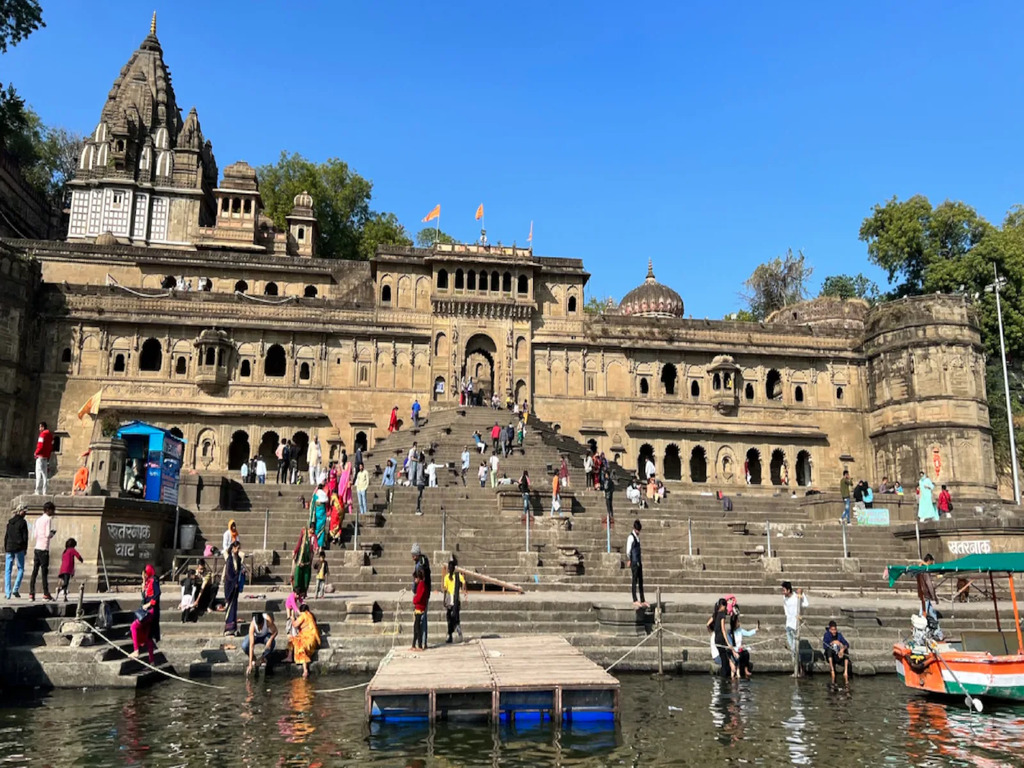
10. Maheshwar Fort: Ahilyabai’s Riverside Haven
Historical Significance
On the Narmada, Maheshwar Fort is a 16th–18th century Holkar stronghold, capital of Queen Ahilyabai Holkar (1767–1795), a hub of Maratha power and Maheshwari sarees.
Description of Place
Envision a fortress by the Narmada’s sacred flow, its ghats kissed by ripples carrying prayers. Maheshwar Fort is a spiritual sanctuary, blending Holkar might with Ahilyabai’s grace. Ahilyabai’s Palace stands serene, its verandas overlooking the river, whispering of compassion.
The Rajwada glows with relics, its walls echoing edicts. Narmada ghats shimmer with temples, alive with pilgrims, while Rehwa Society weaves Maheshwari sarees, threads of royal pride. Maheshwar feels eternal, the Narmada’s chants blending with Ahilyabai’s legacy.
Why You’ll Love It: Maheshwar’s riverside serenity and Ahilyabai’s legacy create a soulful royal escape.
Nearby Attractions
- Baneshwar Temple: Island Shiva shrine (30 minutes).
- Pandrinath Temple: 13th-century site (1 hour).
Duration: 2–3 hours.
Location: Maheshwar, Khargone.
Book your tour via GetYourGuide:
Why Madhya Pradesh’s Forts Are Unmissable
These forts offer:
- Historical Depth: Spanning Gwalior’s ancient roots to Maheshwar’s Maratha pride.
- Architectural Splendor: From Mughal domes to Rajput carvings.
- Cultural Riches: Music, romance, and governance thrived here.
- Scenic Beauty: Hills, rivers, and plateaus frame regal vistas.
They’re living legacies of India’s royal heart.
Sample 5-Day Itinerary
- Day 1: Gwalior: Explore Gwalior Fort; visit Jai Vilas Palace.
- Day 2: Orchha: Discover Orchha Fort; see cenotaphs at sunset.
- Day 3: Chanderi: Visit Chanderi Fort; explore weaving centers.
- Day 4: Mandu: Tour Mandu Fort’s palaces and mosque.
- Day 5: Maheshwar & Indore: See Maheshwar Fort; end at Rajwada in Indore.
Travel Tips
- Best Time: October–March (15–25°C). Avoid summer heat; monsoons are scenic but slippery.
- Getting Around: Airports in Bhopal, Gwalior, Indore. Trains connect cities (e.g., Bhopal–Gwalior, 3 hours). Cabs (₹10–15/km) or autos (₹20–50).
- What to Bring: Sturdy shoes, light clothes, scarf for temples, sunscreen, water, small bills.
- Etiquette: Dress modestly at temples; remove shoes. Ask before photographing locals.
- Safety: Stay alert in crowds; secure valuables.
- Food: Try poha, dal bafla. Carry water for remote forts.
- Connectivity: Airtel/Jio SIMs (₹500). Wi-Fi at hotels; UPI common.
Historical Context
Madhya Pradesh’s forts reflect its role as India’s crossroads:
- Early Medieval: Gwalior and Chanderi guarded trade routes.
- Sultanate-Mughal Era: Mandu and Orchha blended Islamic and Hindu styles.
- Maratha Period: Holkars and Scindias shaped Rajwada and Gwalior.
- Gond Dynasties: Madkheda and Singorgarh embodied tribal resistance.
They were fortresses, palaces, and cultural hubs.
Final Thoughts: A Royal Legacy in Stone
The forts in Madhya Pradesh are India’s royal heartbeat. From Gwalior’s cliffs to Mandu’s ruins, Orchha’s riverside to Maheshwar’s ghats, they weave tales of Tansen’s music, Roopmati’s love, and Ahilyabai’s justice.
These citadels invite you to live their grandeur, where history pulses in every stone. Plan your journey and let Madhya Pradesh’s forts sweep you into a regal saga.


